Win rate is not a success metric.
Profit factor is.
A 68% win rate sounds convincing. In reality it is one of the most misleading metrics in the field. This primer explains why, and what to look at instead.
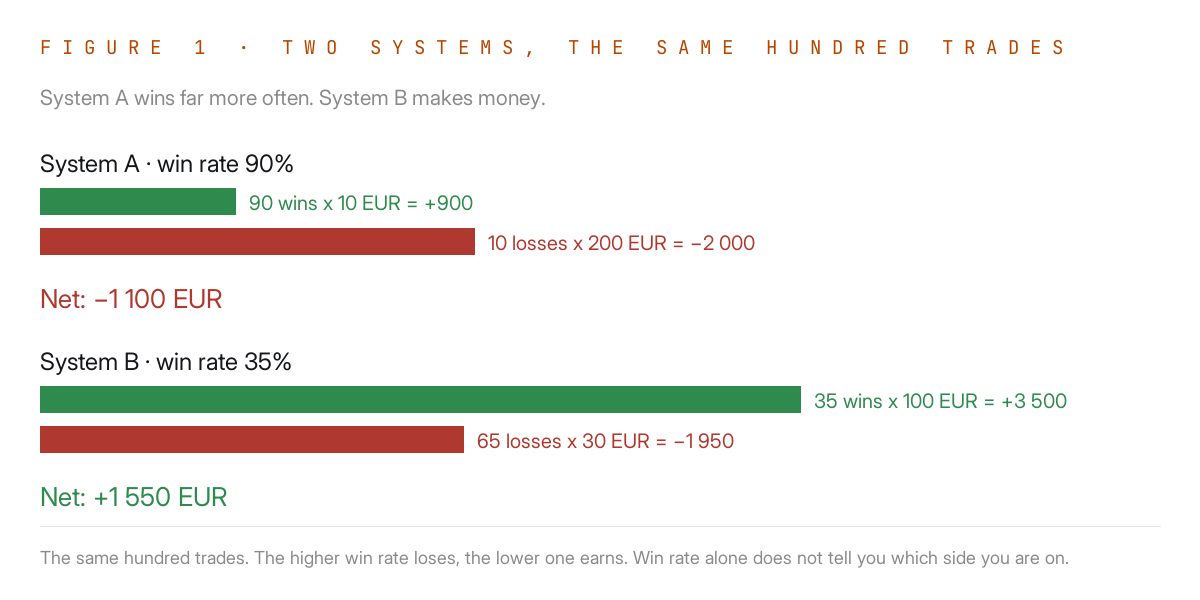
Win rate tells you only ONE thing: how often a trade closed in profit. It says nothing about how big the win was, how big the loss was, or whether the sum of wins covered the sum of losses.
Look at what happens with two imaginary systems, each trading 100 trades:
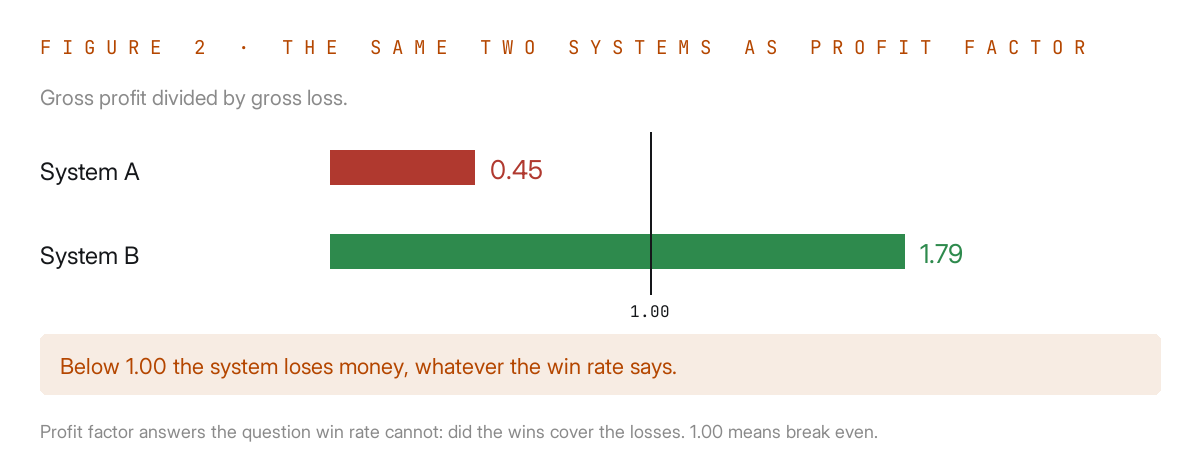
Profit factor (PF), the sum of all profit divided by the sum of all loss. PF = 1.00 means net zero. PF = 1.20 means that for every 1 EUR of loss there is 1.20 EUR of profit. Institutional filters usually look for PF ≥ 1.30. Below 1.00 is a losing system, regardless of win rate.
Let us apply this framework to our flagship signal, Techno Long Term. The figures are a direct snapshot from MQL5 in May 2026.
| Total trades | 4,005 |
| Win rate | 68.31% |
| Best trade | +37.12 EUR |
| Worst trade | −58.93 EUR |
| Profit factor | 1.22 |
| Max balance DD | −30.85% |
| Total growth since inception | +475.52% |
The win rate is strong (68.31%), but on its own it is not a reason to subscribe. The critical number is PF 1.22: for every 1 EUR of loss, 1.22 EUR of profit. The system earns not because the wins are bigger, but because they are more frequent.
Win rate tells you how often a system wins. Profit factor tells you whether it wins at all. The first is emotion. The second is mathematics.
Educational material. This is not investment advice or an offer to buy or sell. Past results do not guarantee future results.
Nice Trader OÜ · LEI 6488HT10Z91OQ3PO8252 · Tallinn, Estonia