How much to risk on one trade.
Position size comes from the stop, not conviction.
Primer 03 made the case that entry is the least important layer of a system and that edge, the durable advantage, is born downstream from it. This issue turns to the first and most durable of those layers: how large a position should be. It is the only decision you make before every trade, entirely under your control and independent of whether the market behaves as expected today.
The wrong question is "How many lots should I buy?" It asks about size in money, and it has no answer, because money is not risk. The right question is "How much do I lose if this trade is wrong?" Once that has an answer, size is calculated, not chosen.
The method itself is short. Decide in advance what share of the account you are prepared to lose on one trade. Look at how far away the stop is. Divide the first by the second. That is position size.
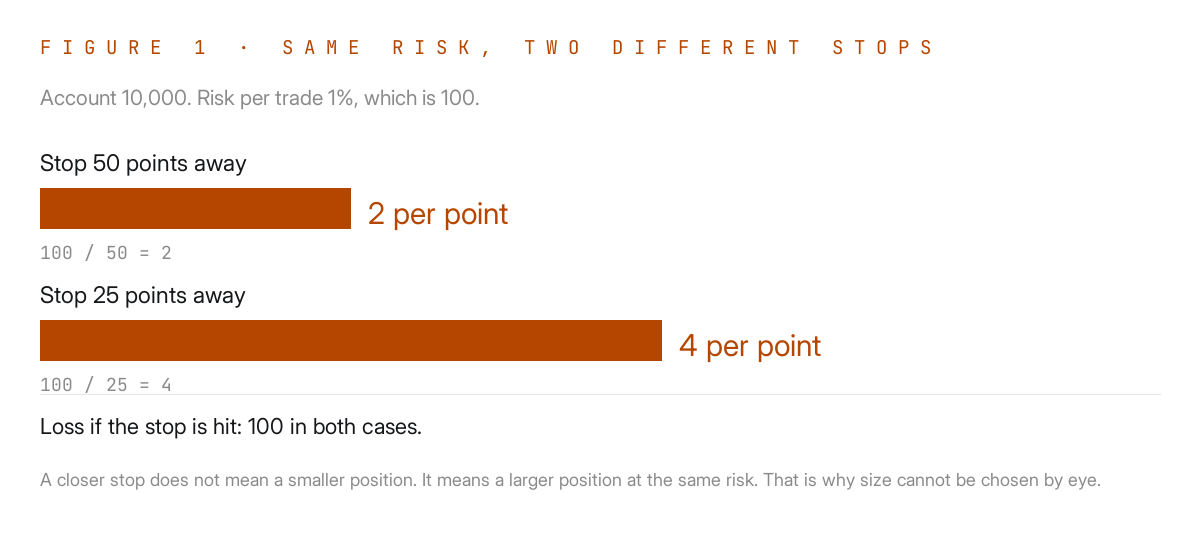
The account does not know which position was opened, because the worst outcome is the same in both cases. It also removes the temptation to put more into the idea you feel more certain about, because conviction is not a measure.
Entry rules wear out. Markets change, and what produced an edge in one decade produces noise in the next. Position sizing does not wear out, because it predicts nothing. It is arithmetic that holds in every market, even when your entry is mediocre.
It is also the only layer that directly concerns ruin. A system that risks one fifth of the account on every trade eventually reaches a point where a normal losing streak becomes fatal, even if its edge is real. At a fixed 1% risk, ten consecutive losses leave about 90% of the account before costs and slippage.
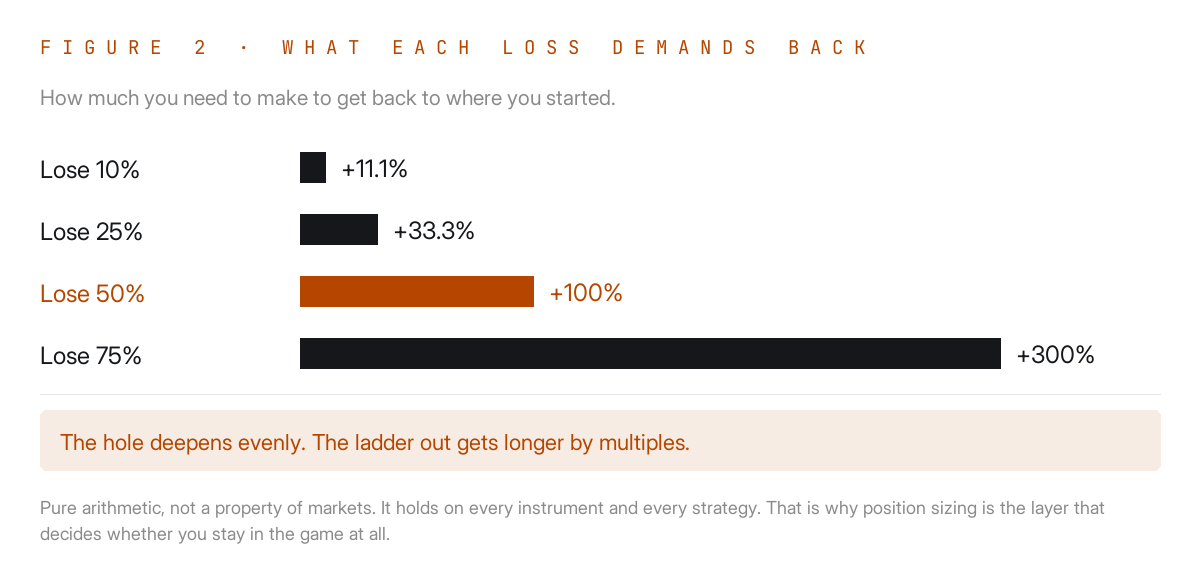
Position sizing is not a brake on returns. It keeps you in the game long enough for the edge to show itself. A loss you recover from in a few months is a cost. A loss that takes a few years to recover from is something else.
The most convincing part is that even people who disagree about everything else arrive here independently. Van Tharp builds his whole framework around position sizing and calls it the place where the result is actually made. Curtis Faith describes the same thing in the Turtle rules: size comes from market volatility, not the trader's opinion. Andreas Clenow calculates size from an instrument's volatility so that each position contributes the same amount of risk to the portfolio. Gary Antonacci reaches the same conclusion from the momentum side: risk control is what preserves the result.
| Fixed percentage of the account per trade | All four |
| Size calculated from the stop or volatility | All four |
| Size chosen by conviction | None of them |
Four independent sources: Tharp, Faith, Clenow, Antonacci. They disagree about entries and markets. They do not disagree about size.
Honestly: a correctly calculated position feels too small for the first few months. That is exactly the sign that the calculation is right. A size that feels exciting is almost always the size that will not survive the losing streak you will get sooner or later. The other cost is boredom. At one percent, one trade does not change your day. That is what makes the result measurable. Then arithmetic speaks, not luck.
Decide the risk first, not the size. Position size is the result of the division that follows. If you do not know where the stop is, you do not know how large the position should be. The trade is not ready yet.
In our systems, this layer is written before the entry rule. Every position carries a hard stop from the moment it is opened, risk per trade is a fixed percentage, and size is calculated from that rather than from a feeling about the situation. That is why our months are modest. The live record is public for anyone to inspect.
Primer 05 looks at exits: why cutting a loss is a simple rule and letting a winner run is a difficult one, and why these same four sources disagree at precisely that point. It was published in September 2026: Cutting a loss is easy, letting a winner run is not.
Educational material. This is not investment advice or an offer to buy or sell. Past results do not guarantee future results.
Nice Trader OÜ · LEI 6488HT10Z91OQ3PO8252 · Tallinn, Estonia