Cutting a loss is easy.
Letting a winner run is not.
Primer 04 said that position size comes from the stop. This issue takes the other end of the same rule. The exit decides how large a win is allowed to be, and it has two halves that are nowhere near equally hard. Everyone quotes the first one. The second is the one that gets broken.
Cutting a loss is one number. You decide it before the trade, it goes to the market with the order, and the trade ends exactly where you said it would. Nothing is left to decide on the day, and that is what makes it easy: no opinion can reach it.
That is why "cut your losses" is the most quoted sentence in the field. It is true. It is also the simpler half of the work.
The other end is not a number, it is a process. Any exit that lets a winner run has to hand back part of the open profit. That is not the result of a mistake, it is a property of the rule: a trailing exit only learns the move is over after it has started, and it pays for that information with the best price the trade ever showed.
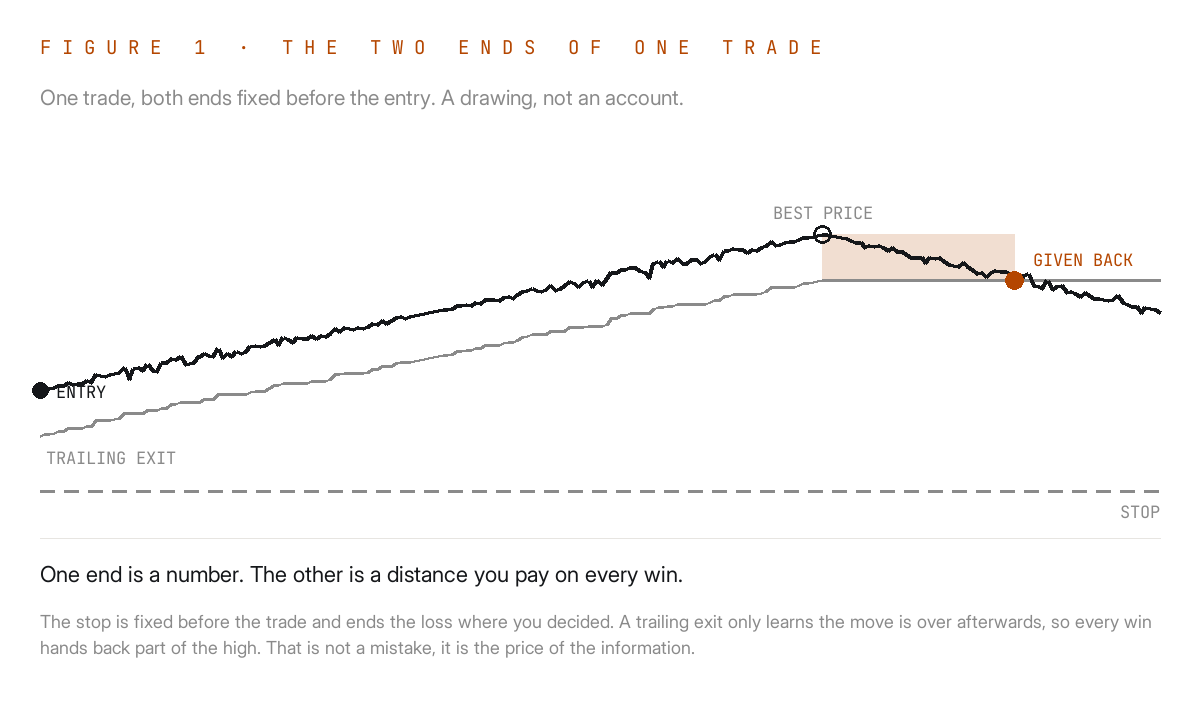
Illustrative numbers, not an account. Replace 10 with any distance you like: it does not disappear, it only gets larger or smaller.
That is the trade-off nobody escapes. The closer the exit follows, the less you give back and the more often you cut a trend short. The further away it runs, the more you give back and the larger the one trade a year that pays for the whole year.
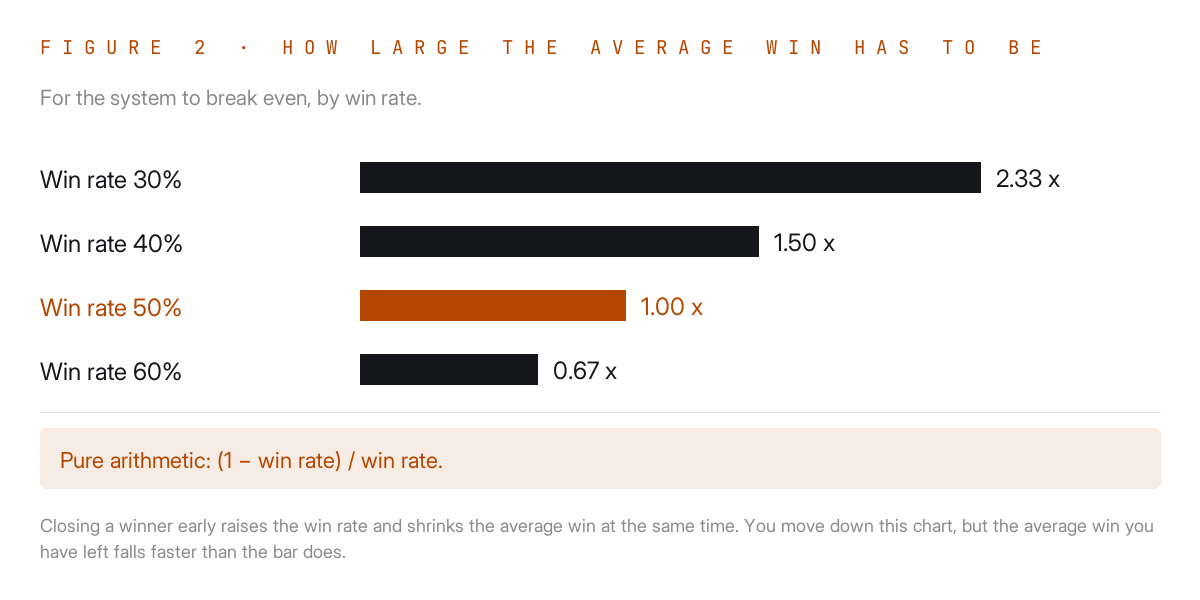
Handing back open profit feels like an error, so winners get closed early. In the moment it even looks good: the win rate goes up, because a small win still counts as a win. The bill arrives in a different column, the average win, and that column decides whether the system survives at all.
Primer 04 ended on four independent sources arriving at the same method for position size. At the exit those same four part company, and that is a lesson in itself: there is no single correct exit.
| The Turtle rules (Curtis Faith) | a new 10-day low, no profit target |
| Andreas Clenow | three ATR under the highest high since entry, no profit target |
| Van Tharp | everything in R: a trailing stop, a target or time |
| Gary Antonacci | no stop at all, the month ends and the position is replaced |
Three of the four carry no profit target. None of them lets an opinion close a trade.
The argument is about what ends a winner. The agreement is that it was written down before the trade. Antonacci exits on the calendar, Faith and Clenow on price, Tharp measures everything in multiples of the initial risk. Not one of them asks how the trader feels this morning.
Honestly: you never sell the high. A system that lets winners run will regularly show you a good trade turning mediocre before it finally closes. What you get in return is the one trend a year that pays for all the small losses. Tighten the exit too far and the small losses are still there, but that one large win never arrives.
Decide both ends before the entry. If you know where the trade ends badly but not what ends it well, the trade is not ready yet.
In our systems both ends live in code. Every position carries a broker-side stop from the moment it opens, a trailing stop only ever moves in your favour, and where the rules call for it there is also a time limit or a close before the end of the day. Nothing is closed by hand. Not because the hard half is hard to calculate, but because it is hard to sit through.
Primer 06 looks at diversification: why two systems on the same instrument are not diversification, and how correlation quietly removes the protection you thought you were buying. It arrives in October by email through Substack and appears on this site at the same time.
Educational material. This is not investment advice or an offer to buy or sell. Past results do not guarantee future results.
Nice Trader OÜ · LEI 6488HT10Z91OQ3PO8252 · Tallinn, Estonia